Introduction
The internet is no longer where seeing is believing. A video of a global figure declaring war, a voice recording in which a CEO is giving the green light to a wire transfer, a video conference where a person who looks exactly like your coworker is talking all of that can be created within minutes with the help of the free tools that can be found on the internet. In the recent past, deepfakes, a relatively small issue that was limited to scholarly articles and even science fiction, emerged as one of the most disruptive threats to businesses, governments, and even individuals today.
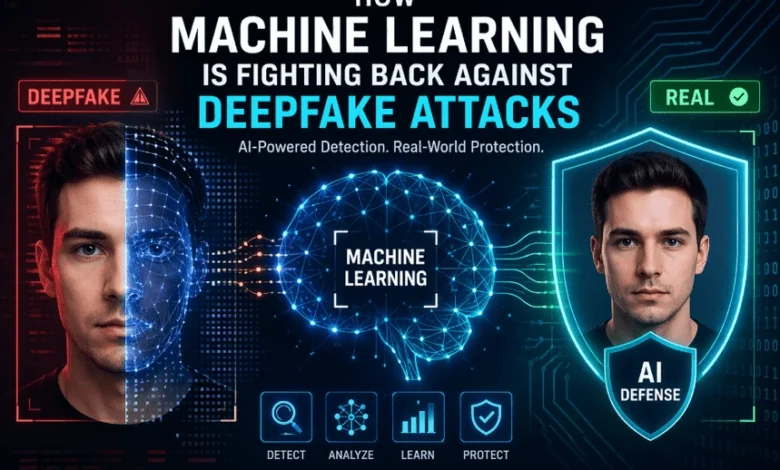
However, with the advancement of deepfake technology, so has the technology that has been developed to overcome it. The same family of techniques that is used to generate synthetic media is now the first line of defense against it, machine learning. From behavioral biometrics to frequency-domain forensics, a new generation of AI-detection systems is being trained to identify what even the human eye fails to notice. This article discusses the progress of that fight, the state of the technology, and the future of the technology.
The Magnitude of the Deepfake Issue
To grasp why machine learning has become the key to deepfake defense, it is best to first evaluate the magnitude of the threat. In 2022-2025, deepfake frauds grew more than 3,000 percent, as per various industry reports. Banks, especially, have been the target. Hackers have become so accustomed to using face-swap algorithms to pass video-based KYC solutions in the course of remote onboarding that they submit synthetic video instead of a live selfie as a way of opening fraudulent accounts or stealing existing ones. Corporate AI voice clones have been utilized to impersonate executives and make fraudulent payments – a threat category that has already cost organizations hundreds of millions of dollars worldwide.
The technology behind this has democratized at an astounding rate. What used to take a Hollywood visual effects house and several months of post-production is now possible on a consumer laptop, an open-source program, and some source footage in a few minutes. Both generative adversarial networks (GANs) and diffusion models have made the generation of synthetic media cheap and accessible, as well as simple, and delivered a potent weapon into the possession of bad actors across all levels of sophistication.
The Process of Machine Learning to Detect Deepfakes
The fundamental problem of detecting deepfakes is that the synthetic media is designed to deceive the human visual and auditory system – and it is becoming more effective. Machine learning systems do not, however, have a limit on what humans can perceive. They can be trained to detect patterns, artifacts, and anomalies that do not appear statistically (when a person is watching a video) but can be detected with the appropriate model architecture.
Spatial Artifact Analysis CNNs fed with high-resolution datasets of both real and synthetic faces can detect faces with subtle differences in their structure, skin tones, and lighting effects, as well as the edges of the blend between a synthetic face and a background face. Images created by GANs, especially, are prone to making typical errors in the form of teeth, ears, hair edges, and eye reflections – things that the model finds it difficult to create in a natural way at high resolution. Detection CNNs are trained to put much weight on these areas when classifying.
Temporal Coherence Detection
One-frame analysis is no longer as effective against modern deepfakes, which can confuse spatial detectors frame-by-frame. Transformer-based and recurrent neural networks cope with this by studying the entire time course of a video. Natural human movement is physiologically regular – natural micro-tremors, natural smooth eye saccades, regular blinking, consistent head movement. Deepfake generators find it much harder to reproduce this temporal coherence over dozens of consecutive frames, and sequential models are conditioned to see these discrepancies as indicators of suspiciousness.
Frequency Domain Forensics
A method of detection that is technically the most elegant is not in pixel space, but rather in the frequency domain. As images are run through Fast Fourier Transform (FFT), GAN-generated content results in typical artifacts, which are of high frequency and statistically different compared to photographs taken by cameras. Even heavily post-processed or compressed spatial output can be detected by detectors in this domain, which can be particularly important since deepfakes are frequently shared on social media platforms that use lossy compression.
Physiological Signal Extraction
One truly effective method of detection takes advantage of the fact that human biology is something deepfake generators can not replicate. Remote photoplethysmography (rPPG) is a computer vision method that measures the small, periodic color variations in the skin due to blood pulsations underneath the skin. These alterations are invisible to the human eye but can be found in real video recordings and can be extracted by algorithms. Existing generative models do not generate a physiological signal of such nature, so rPPG is a trustworthy discriminator between real and synthetic subjects – especially in the context of live video verification.
Multimodal and Active Liveness Detection
The strongest detection systems are not based on a single signal. Multimodal methods are audio-visual analysis (checking synchronization errors between lip movement, voice parameters, and ambient acoustics) and active liveness issues compelling the subject to react to the unpredictable real-time stimuli. A random head turn request, an unscripted speech repeat, or asking the user to hold up a particular count of fingers in real time foils pre-recorded injection attacks and replay fraud but provides rich behavioral data to the underlying detector model to analyze.
Identity Verification with Machine Learning
Untrustworthy industries: In the case of financial services, healthcare, digital asset platforms, and telecommunications, where regulatory oversight arises, ML-based deepfake detection software became not a competitive edge, but a compliance mandate. Regulations such as the EU Anti-Money Laundering Directives, eIDAS 2.0, and new AI Act laws are becoming clearer on why certified liveness detection must form a component of any remote identity verification process.
The most prominent identity verification systems today combine multiple detection indicators at once instead of using a single check. Passive liveness detection operates in the background throughout a session and considers dozens of signals, without introducing friction to the user experience. On top of it is a secondary layer consisting of active challenge-response mechanisms. Additional dimensions to the risk assessment are document authentication, behavioral biometrics, and device fingerprinting. A new user can post a selfie or engage when they post.
Some organizations are exploring federated learning arrangements that allow institutions to collaboratively improve detection without sharing sensitive user data an approach that addresses both the data hunger of detection models and the privacy constraints of regulated industries.
Conclusion
Deepfakes represent one of the most consequential applications of generative AI, not because of any single dramatic incident but because of the quiet, systematic way they are eroding the trust infrastructure that digital commerce and communication depend on. Machine learning is the most credible answer the security community currently has not a perfect answer, but an evolving one.
The organizations best positioned to manage deepfake risk are those that treat detection not as a one-time configuration but as an ongoing capability: continuously updated models, layered signal analysis, regulatory alignment, and a realistic understanding that the adversary is also learning. In that sense, the fight against deepfakes is less a technical problem to be solved than a discipline to be maintained — and machine learning is the discipline’s most powerful tool.