The 24/7 market access is one of the biggest boons of cryptocurrency that has been heralded as such since the beginning of Bitcoin. Trading of digital assets is non-stop, non-hours, weekend-free, holiday-free. As a theory, this will make crypto markets more efficient and responsive than traditional financial markets, which do not go beyond the limits of exchange hours and geographical boundaries. Events of recent times have however brought into reality a harsh reality. Crypto is not immune to geopolitical shocks, in fact, continuous trading can even make these shocks more significant.
As the conflict between the U.S. and Iran intensifies with the new U.S. and Iran clash, the world market has been shaking, and cryptocurrencies have been in the middle of it. The crypto claim that it serves as a hedge or safe haven always is one that has been tested under the pressure of real world geopolitics and in most aspects has proved its limitations.
Cryptocurrencies Weekend Shock: The Crypto Got the Global Panic
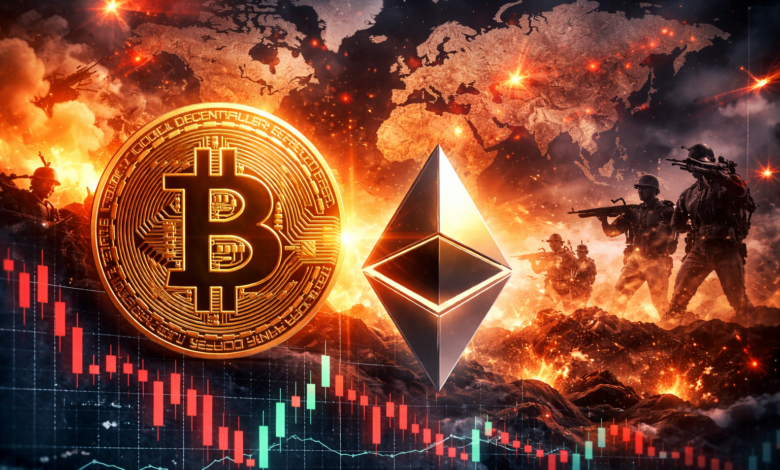
In the late of February 2026, the US and Israel undertook joint military attacks against Iran, which caused an abrupt increase in the geopolitical risk. As regular markets stocks, bonds, and foreign exchange were shut down over the weekend or had limited liquidity, crypto markets stayed open and made transactions around the clock in different time zones. Bitcoin fell as much as 6 percent in several hours, falling between about 68,000 and about 63,000 traders scrambling to incorporate the increased risk and uncertainty. Other key altcoins like Ethereum dropped in the same manner.
Since crypto does not go to sleep during a trade, it remained the sole key market that values global geopolitical risk that day. Markets did not have time to digest news because, unlike the traditional markets, they had to deal with events in real time, without the circuit breakers and structured pauses that conventional markets provided. The outcome was a turbulent spill-over of price action, sharp sell-offs and fast recovery as the mood changed between panic and buy-on-the-run.
This interaction established a feedback system. The crypto markets were the first responders to the fear of geopolitics, and not because it was an asset class based on economic fundamentals. The liquidation of leveraged positions occurred quickly when sold off and some data reported excessively high liquidation activity in a 24 hour period which is indicative of the instability of markets being forced.
Essentially, the 24/7 crypto meant that what would have been a closed weekend in equities was an active geopolitical market that exposed crypto to risk of taking the place of other markets that had time to digest.
Volatility is not a Savior: Crypto as a Risk Asset
Another common error in previous years was the notion that Bitcoin or crypto, in general, could be used as a safe haven like gold in the situations of world turmoil. However, the reaction of the markets in early March 2026 is a different story. As the conflict unfolded:
- Bitcoin was highly volatile with highs and lows of thousands of dollars during one trading session.
- Ether and XRP curved downwards as risk off sentiment increased.
- Cryptocurrency markets were risk-sensitive, leveraged and fear-driven, as opposed to non-tethered hedges.
- Though briefly recovered to the high range of the 60s,000s, a lot of the recovery was due to tactical trading rather than any underlying change of purpose in Bitcoin as a risk asset.
Trading a traditional geopolitical market when a major geopolitical event occurs is usually stopped or re-opened with protective measures like circuit breakers. There are no such mechanisms in crypto, and it is why virtually any significant geopolitical shock is experienced in real-time and to the fullest extent.
Illusion of Round the Clock Risk Transfer
The fact that markets must never be closed to global risk of prices has been used as one of the arguments supporting crypto trading 24/7. Some of these exchanges recorded a sharp increase in 24 hour trading volatility as traders attempted to hedge macro risk.
Yet here there is a twist to this ever-on hedge. Price discovery under the influence of every participant in the market simultaneously responding to the same news becomes compressed over thin liquidity windows, particularly during times not in the regular business hours. CryptO becomes the only risk repricing zone because there is no other market to redistribute the risk or give different pricing indicators. Continuous trading, which was meant to be the advantage of crypto, increases volatility in times when markets are exposed to significant global events.
Global Markets Respond: Economy Wide Impact
The war was not the only way that crypto was swept into a whirlpool of volatility. It spread across the financial markets in the world:
- The UK and European stock indices plunged as the energy prices rocketed.
- The oil price rose by almost 7 percent, which signifies extensive macroeconomic tightening strains.
- The investor flows into the safe havens such as the U.S. treasuries and gold.
Within the framework of global markets, the crypto movements turned into a leading indicator and not a haven, considering that it was exposed to risk sentiment 24 hours a day.
Risk Management and Leverage: Two Sided Sword
The fact that the trade is 24/7 also implies that leverage, the bread and butter of crypto derivatives, will be more perilous in the case of geopolitical shockwaves. The leveraged positions are wiped out within hours instead of days or weeks with the possibility of the prices shifting hundreds or even thousands of dollars in a matter of hours.
This type of rapid liquidations also adds to volatility, as well as deterring long term holders that would otherwise have used crypto as a hedge. Rather, the market becomes more of a reaction engine, with short term betting and automated risk management systems. The unusual long liquidations that were experienced in the recent volatility reflected this dynamic.
The Future of Cryptocurrencies in World Finance: It is Undergoing Development
Nevertheless, crypto is not irrelevant despite the problems. Its quick reactions to news of geopolitical interest may one day turn it into a useful real time gauge of global feeling. Cryptocurrency markets are becoming more popular as investors and institutions use them to give macro opinions, but do so in a completely different way than is the case with conventional assets.
Additionally, creation of financial primitives like tokenized real world assets that exchange on blockchain platforms might expand 24/7 risk pricing to cover other than crypto tokens. Yet whether this will indeed translate into more positive market results, or is merely a more efficient way of distributing volatility around, is an open question.
Regulatory and Structural Considerations Ahead
Thus, as governments navigate through the above-mentioned factors, their interventions may result in the following outcomes for the role of crypto in the future:
- Regulatory clarity may help increase participation in the market from an institutional investor base, potentially helping to dampen volatility.
- On the other hand, countries that face economic sanctions have previously used cryptocurrency as a means of an alternative financial system, making the geopolitical situation more complicated for regulatory oversight.
- The geopolitical situation, regulatory scenario, and market structure may help crypto grow into a more stable financial system, or it may remain a reactive 24/7 market.
Conclusion: The 24/7 Advantage Reassessed
Perhaps the most revolutionary aspect of crypto, however, remains the dream of constant and seamless trading around the globe. This, of course, allows for constant and timely reactions to events around the world. However, as the recent string of geopolitical events have demonstrated, perhaps the very aspect of crypto that allows for this timely reaction to events around the world may have become its worst enemy, particularly in an environment where risk appears to have no borders and crypto appears to have no safe haven.
Perhaps the dream of round-the-clock protection against the vagaries of the world remains an aspiration, but only if the environment in which it operates changes to accommodate this. Otherwise, perhaps crypto’s edge of round-the-clock trading may only continue to resemble a double-edged sword in a world where conflict never sleeps.